
A coffee cart packing list needs ingredients, serving supplies, equipment, cooling supplies, and backups. Start with the event’s guest count, service window, and menu, then give your team a checklist they can use while loading the cart.
Need quantities for a specific event? Use the coffee catering calculator to work out coffee, milk, drink ice, water, cups, and lids. This guide explains how to turn those quantities into a packing plan, including the supplies and preparation the calculator does not cover.
This guide explains Goodhart Coffee’s packing defaults, with operational advice from Justin Goodhart’s podcast conversations and questions raised inside Mobile Business School. The defaults come from Goodhart’s internal packing calculator; the podcast citations support the method and operating advice, not an independent measurement of every ratio.
All gallons and quarts below are US liquid measures. Milk ounces are fluid ounces; coffee and ice pounds are weight.
Coffee cart packing checklist
Use this as a starting checklist, then add what your menu, equipment, and venue require. Assign someone to check each group before departure.
| Packing group | What to check |
|---|---|
| Coffee and menu ingredients | Espresso beans, decaf if offered, syrups, sweeteners, and ingredients for chai, matcha, or other menu drinks |
| Milk | Whole milk, alternative milks, and half and half according to your menu and expected usage |
| Cups and serving supplies | Cups, matching lids, napkins, stirrers, and straws where needed; divide the combined cup count if you use separate hot and cold cups |
| Drink ice and cooling supplies | Ice served in drinks, plus separate cooler ice or cold packs for milk; coolers and an ice scoop |
| Water and cleanup | Filled water supply, backup water, wastewater containers, towels, and cleaning supplies for your setup |
| Cart and equipment | Espresso machine, grinder, scales, tampers, pitchers, and the power and water connections your setup requires |
| Backups and event brief | Spare essentials in a separate checked container, printed quantities, menu, service times, venue access details, and the client contact |
The calculator supplies the core consumable quantities. Check menu extras, cooling supplies, and equipment separately. Goodhart uses 12 oz paper cups for both 8 oz hot drinks and 12 oz iced drinks; its drink-ice estimate excludes cooler ice.
For the handoff to your team, jump to how to make a packing list your staff will use. The sections below explain how to size and adjust the consumable quantities.
Plan the event: guests, drinks, and baristas
Set the guest count and service window first, then check that your team can serve the event.
How many drinks should I plan per guest?
Start with 1 drink per guest. Some people order twice and some do not order at all. In Goodhart’s experience, those generally balance out. That is the expected drink count before adding any spare supplies.
Running out of coffee is a bad look, so Goodhart packs a buffer he has fine-tuned through experience:
- Regular events: pack 20% extra, or 1.2 times the expected drink count.
- Slower events: pack 30% extra, or 1.3 times the expected drink count. When the cart has little or no line, more guests come back for another drink.
The calculator uses expected drinks divided by hours and baristas to estimate pace. When baseline demand fits service capacity, at or below 40 expected drinks per barista-hour it uses the slower-event buffer. Above that, it uses the regular buffer. These are practical packing bands, so crossing into the regular band can reduce the packing total even when the guest count rises slightly.
The buffer is extra inventory, not a forecast that everyone will drink more or a promise that your team can make more drinks.
The separate minimum for small events
When baseline demand fits service capacity and pace is at or below 30 expected drinks per barista-hour, Goodhart also keeps a minimum of 35 drinks of supplies per barista-hour. Use whichever is higher: the slow-event buffered amount or this minimum. Do not add the full minimum on top of the buffer.
For 50 guests over 2 hours with 1 equipped station, expect 50 drinks. The 30% buffer adds 15. The minimum adds another 5, bringing the packing list to 70 drinks of supplies.
What if the client cannot give me a guest count?
For a trade show, fair, or brand activation with unknown attendance, plan around your service capacity: drinks per hour × service hours × independently equipped baristas. Use that capacity as the planning count in the calculator; it adds the packing buffer. Agree on the service window and output limit with the client instead of promising a drink to everyone attending the venue.How many drinks can one coffee cart actually make in an hour?
Goodhart’s rule of thumb is 50 drinks per barista-hour. The calculator counts independently equipped barista stations. Multiply drinks per station-hour by service hours and stations to estimate capacity. A second person sharing a machine may help take orders or finish drinks without doubling production. Adjust throughput to your actual setup and menu.
In episode 45, Justin explains that steam capacity can limit hot-drink production on a single-group machine using a standard wall outlet. The default is a planning rule, not a universal mechanical limit or a guarantee about how quickly every machine can serve.
Capacity and packing are separate. For 150 guests over 2 hours with 1 equipped station, expected demand is 150 drinks but capacity is only 100. Because the team is already at capacity, it uses the regular-event buffer. The calculator flags the shortfall and packs for the 100 serviceable drinks plus a 20% inventory buffer: 120 drinks of supplies. That extra inventory does not close the service shortfall.
Extend service to 3 hours or use 2 independently equipped barista stations to cover the baseline of one drink per guest. These staffing suggestions cover baseline demand, not every possible refill. With the extra equipped station, the event has capacity for 200 drinks and packs for 195, including its slower-event buffer.
Why do guests rush the cart in the first few minutes?
Operators in the community describe long lines during the first 20 minutes. That is a recurring question, not a measured rush duration for every event. An average drinks-per-hour figure cannot tell you how long a guest will wait during a sudden break between conference sessions.
Ask when guests can actually visit the cart. A long event with a short coffee break needs a different service plan from steady arrivals throughout the day. Have the menu and supplies ready, pace the machine, and tell the client what the setup can produce during that window. In episode 45, Justin explains that a longer line does not remove equipment and staffing limits.
Does a bigger menu slow service?
Extra preparation steps, toppings, and choices can slow service. Justin recommends familiar drinks and basic alternative milks, with chai and matcha also on Goodhart’s menu. Test your actual menu before raising the calculator’s throughput assumption, and pack ingredients for those drinks separately. Hear Justin’s menu advice in episode 64.
Should I pre-batch drinks or make them to order?
Community operators describe batching for larger events and making drinks to order at smaller services. Use the expected demand and the complexity of your menu to decide what can be prepared ahead. Small batches make it easier to adjust without committing all your ingredients to a drink that may not sell.
Test your recipes and handling workflow before the event. Batching changes preparation time; it does not establish how long a finished drink can be stored. Use your established recipe and handling procedures.
Coffee and milk quantities
Use the drink count to size your supplies, then adjust for your menu and milk choices.
How do I calculate coffee and milk for an event?
A latte recipe tells you how much milk goes into that drink. Packing an event also requires knowing how many guests will choose it.
Some guests choose whole-milk lattes, others choose oat, and some order americanos with a splash of milk or black coffee. If you pack a full latte’s worth of whole milk for every drink, you overpack dairy and still have no idea how much oat to bring.
A yield collapses all of that into one number per item. “One gallon of whole milk covers about 40 drinks” already accounts for the drinks that take no whole milk at all. Each item gets its own yield, each yield is independent, and you never stack them or split them by drink type.
Justin explains the same method in episode 33: track how much service you get from a carton or gallon, then calibrate the quantities to your operation. A spoken example in that conversation is not a replacement for the current calculator defaults.
How many espresso drinks come from a pound of coffee?
About 25 double-shot drinks per pound at an 18 g dose. A 5 lb bag covers roughly 125 drinks.
Each drink here uses one double-shot extraction, not one single shot. This is the theoretical dose yield before dial-in waste or discarded shots; the event packing buffer provides extra supplies but is not a measured waste allowance.
The math: 453.6 grams in a pound, divided by 18 grams per double shot. If you use a larger dose or serve extra-shot drinks, increase the dose accordingly. The calculator lets you change the dose.
Drip coffee stretches much further per pound because the dose per cup is lower. That is a different service with different math, and this post is about espresso.
How much milk is in a latte?
Milk per latte depends on your recipe, cup size, and whether the drink is hot or iced. For packing, use your event-wide milk yields to account for the menu mix as well.
How much oat and almond milk should I plan for coffee catering?
Justin Goodhart’s rule of thumb for milk choices is 56% whole milk, 28% oat, and 16% almond. That means planning for about 44% alternative-milk orders, with more oat than almond. The calculator’s default milk yields build this mix into your packing list and round up to whole gallons and quarts. Start here, then adjust the yields to match your audience and what you use at events.| Milk choice | Share of orders |
|---|---|
| Whole milk | 56% |
| Oat milk | 28% |
| Almond milk | 16% |
That puts alternative milks at about 44% of milk orders. The coffee catering calculator builds this mix into its default milk yields, then rounds the packing quantities up to whole gallons and quarts. Half and half is packed separately.
Use Justin’s mix as your starting point. After each event, record how much of each milk you used and adjust the calculator’s yields to match your audience. Expecting an oat-heavy crowd? Lower the oat-milk yield to pack more.
How many drinks does a gallon of whole milk cover?
About 40 total drinks across the event menu. That is not the number of whole-milk lattes a gallon makes.
This is the number people push back on, so here is what it means. Across a normal menu mix, one gallon of whole milk stretches across about 40 total drinks once you count the oat drinkers, the black coffee people, and the splash-of-milk americanos. For an all-latte menu, calculate milk from your own recipe and cup size instead.
If you expect more dairy lattes, lower the whole-milk yield to pack more. If you expect fewer, raise it. The default is an operating rule Goodhart has refined through experience.
How much oat milk and almond milk should I bring?
A quart of oat covers about 20 drinks. A quart of almond covers about 35.
Goodhart’s defaults allocate more oat than almond to match Justin’s milk-choice heuristic above. The calculator rounds up to whole quarts and includes packaging hints in the copied list.
How much half and half?
A quart covers about 90 drinks. It is a garnish for the drip and americano crowd, not a base. Pack by drink count, not service duration: the worked example below needs 2 qt.
Ice, water, and serving supplies
Plan drink ingredients alongside the supplies that keep the cart running.
How much ice do I need, and does that include the milk cooler?
The calculator’s 10 lb bag per 150 packed drinks is ice served in drinks only, based on Goodhart’s mixed hot/iced menu. It does not include ice or cold packs used to chill milk.
Pack those as two separate requirements. A cooler’s stated volume alone cannot tell you how much drink ice remains after cartons and cooling supplies go inside. We do not have a validated cooler-ice quantity per guest to add automatically.
In episode 56, Justin points out that warmer milk consumes more ice when making iced drinks. More iced orders and warmer ingredients both change the plan. Lower the calculator’s drinks-per-bag yield to pack more drink ice, and use your own cooler setup and event conditions to plan cooling supplies.
How much water does an espresso cart use?
About one gallon per 20 drinks, including rinsing pitchers and purging the steam wand. This is a supply estimate, not a tank-size requirement.
For services lasting 3 hours or longer, bring a second wastewater jug. The calculator reminds you.
How many hot cups, cold cups, and lids should I bring?
Goodhart uses one 12 oz paper cup for both hot and iced service. It holds an 8 oz hot drink or a 12 oz iced drink. Cup size is not the same as drink size. This simplifies packing and removes the need to predict two cup types.
Those drink sizes are baked into the calculator’s milk yields. Bigger hot drinks need more milk and steaming; adjust your packing yields if you serve different sizes.
The cup result is a combined total of one cup per packed drink, with matching lids. If you prefer separate hot and cold cups, estimate the mix for your event and divide that total. We do not have a universal hot/cold percentage. Use the menu, weather, and your event history, and bring spare cups of both types.
For branded service, confirm the paid branded quantity with the client and include blank backup cups. Goodhart buys 25 cups and 50 lids per sleeve; use your own supplier’s packaging when ordering.
Worked example: an event packing list
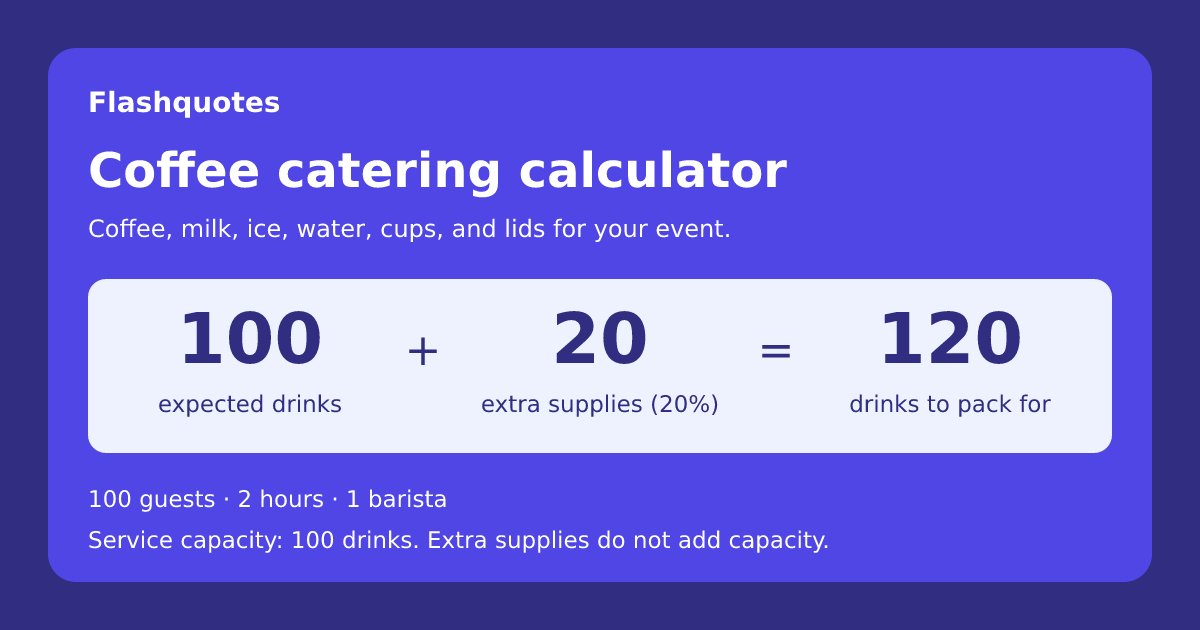
For 100 guests, 2 hours, and 1 equipped barista station, expected demand is 100 drinks. Service capacity is also 100 drinks, based on 50 per barista-hour.
Pack 20 extra drinks of supplies as a 20% buffer, for a total of 120. This is spare inventory to reduce the risk of running out; it does not mean one barista is expected to serve 120 drinks in that time.
| Item | Yield | Exact | Pack |
|---|---|---|---|
| Coffee | 18 g per drink | 4.76 lb | 5 lb |
| Whole milk | 40 drinks per gal | 3.00 gal | 3 gal |
| Oat milk | 20 drinks per qt | 6.00 qt | 6 qt |
| Almond milk | 35 drinks per qt | 3.43 qt | 4 qt |
| Half and half | 90 drinks per qt | 1.33 qt | 2 qt |
| Ice for drinks only | 150 drinks per 10 lb bag | 0.80 bags | 1 bag |
| Water | 20 drinks per gal | 6.00 gal | 6 gal |
| Cups and lids | 1 per drink | 120 | 120 |
Everything rounds up to the unit you buy. Coffee to the nearest half pound, milk to whole gallons and quarts, ice to whole bags. The percentage buffer is applied to the drink count first; purchase-unit rounding can add a little more inventory.
Calculate supplies for your guest count with the coffee catering calculator. It carries these yields as defaults and lets you change every one of them.
Pack with your team and improve the next event
Turn the quantities into a loading checklist, then use what happens at the event to improve the next one.
How do I make a packing list my staff will actually use?
The recurring community question is how to turn supply calculations into an event brief. A list that stays on the owner’s screen does not help someone loading the van.
- Calculate this event. Use the guest-count reference table as a starting point, then enter the actual hours and staffing in the calculator. Recalculate instead of multiplying a smaller event’s list: buffers and capacity change with pace.
- Print and check it off. Use “Print or save PDF,” attach the list to the event brief, and have the person packing mark what is loaded.
- Add the menu and equipment checklists. Include syrups, decaf, chai, matcha, straws, towels, the ice scoop, power and water connections, and anything sold as an add-on. The calculator’s consumable quantities are only part of the load.
- Label the boxes. Justin’s warehouse tour shows labeled boxes with QR codes opening their contents lists. Make it clear which box belongs to the cart and which items belong inside.
- Pack backups separately. In the conversation with Cynthia Jaquez, Justin explains that a backup in the same forgotten box cannot rescue an event. Keep the practical spares for your setup in a separate, checked container.
- Close the loop after service. Record what was used, missing, damaged, or left over, then restock the standard kit. The next event’s packing list should reflect what you learned.
For the cart layout and backup systems behind that workflow, see the free coffee cart masterclass.
How do I know how many drinks we actually served?
Count finished drinks with a clicker or an order tally. Use cup inventory, grinder counters, and coffee usage as cross-checks. Community operators describe using these methods together when clients ask how the served count was calculated.
A grinder counter measures doses, not every finished drink: dial-in shots and remakes can inflate it, while chai and matcha may never use the grinder. Cup counts also need to account for damaged or discarded cups. Agree on the reporting method with the client before the event.
Track the finished count alongside leftovers by item. That gives you a better basis for adjusting yields than either attendance or coffee-bean weight alone.
Does packing extra supplies create waste?
Goodhart uses a 20% packing buffer for regular events and 30% for slower events, where shorter lines encourage repeat orders. Unused cups can return to inventory, as Vienna Christ explains on the podcast. Spare supplies are not the same as discarded drinks, although melted ice and opened or prepared ingredients can still create waste. The percentages are Goodhart's packing defaults, not figures measured in that podcast episode. Vienna Christ on unused supplies and inventory.Adjusting the yields for your menu
The defaults are Goodhart’s operating rules, not universal averages. Adjust them to your menu and what you used at previous events:
- More dairy lattes: lower the whole-milk yield to pack more dairy.
- More oat orders: lower the oat yield and adjust whole milk to match your expected menu mix.
- Summer or outdoor afternoons: lower drinks per bag to pack more ice.
- Long services: water yield is fine, but pack the second wastewater jug and a backup fresh-water jug.
- Faster or slower service: adjust drinks per barista-hour to your measured throughput.
Keep notes after every event. Consistent leftovers or shortages are a reason to adjust your yields.
Sources and next steps
Justin Goodhart, Flashquotes co-founder, runs Goodhart Coffee, one of the largest coffee caterers in the country. These yields are the ones his team packs by, pulled from the calculator they use internally. The warehouse tour shows how the calculator fits into packing. The supply discussion in episode 33 explains calibrating yields to the operation. Neither is a published event-by-event dataset.
The baseline, buffers, and small-event minimum on this page are the Goodhart defaults Zach confirmed for this calculator. Community questions guide the topics; they do not establish population-wide averages or independently validate these percentages. He walks through the equipment side of the same operation on the coffee cart equipment playbook episode of the podcast, and the operational systems behind it in the free coffee cart masterclass.
If you want to compare your own yields with other operators, that conversation happens in Mobile Business School.
And once the list is packed, the next job is pricing the event. Our guide to how much coffee cart catering costs covers that with real booking data.